Key insights:
What legal operations actually involves
Legal operations is the function responsible for how a legal department works as an operational unit. It covers the processes, systems, templates, approvals, and reporting that determine how contracts are created, reviewed, approved, signed, stored, and renewed.
In most organisations this is not a large team. It is usually one or two in-house lawyers who, alongside their substantive legal work, also own the systems and processes the department runs on. They are the person who decides where contracts are stored, which templates exist, how approvals are tracked, and whether renewals get caught in time.
This is important context for everything that follows. A small team with growing contract volumes and limited tooling is not a niche situation. It is the default. The operational pressure that legal ops practitioners describe, too much volume, too little visibility, too many manual steps, is a direct consequence of this structural reality.
Why legal ops teams end up reactive
Most in-house legal functions start without any deliberate process design. Contracts are handled informally. Templates are built by individual lawyers and saved locally. Approvals are requested by email. Signed documents go back into an email thread or a shared folder with no consistent naming, no metadata, and no way to surface what is expiring.
This works at low volume. It stops working as the organisation grows.
The problem is not that lawyers are disorganised. It is that the processes are built on individual memory and effort rather than on systems. When volume increases, everything that relied on a person remembering to follow up starts to fail.
"I will save stuff whenever it comes across my desk. But I might be involved during the drafting and then the signature comes along and people forget to send me the documents and given the volume, I'm not really able to catch up with them." Legal Counsel, a German innovation and entrepreneurship center
"They go live, and two years later, we noticed that we don't have the agreement signed." In-House Legal Counsel, a global fintech company in payment solutions
The result is a legal team that spends most of its time on routine work it cannot delegate, has limited visibility into its own contract portfolio, and is permanently behind rather than ahead of the business.
The maturity model: where does your legal ops function sit?
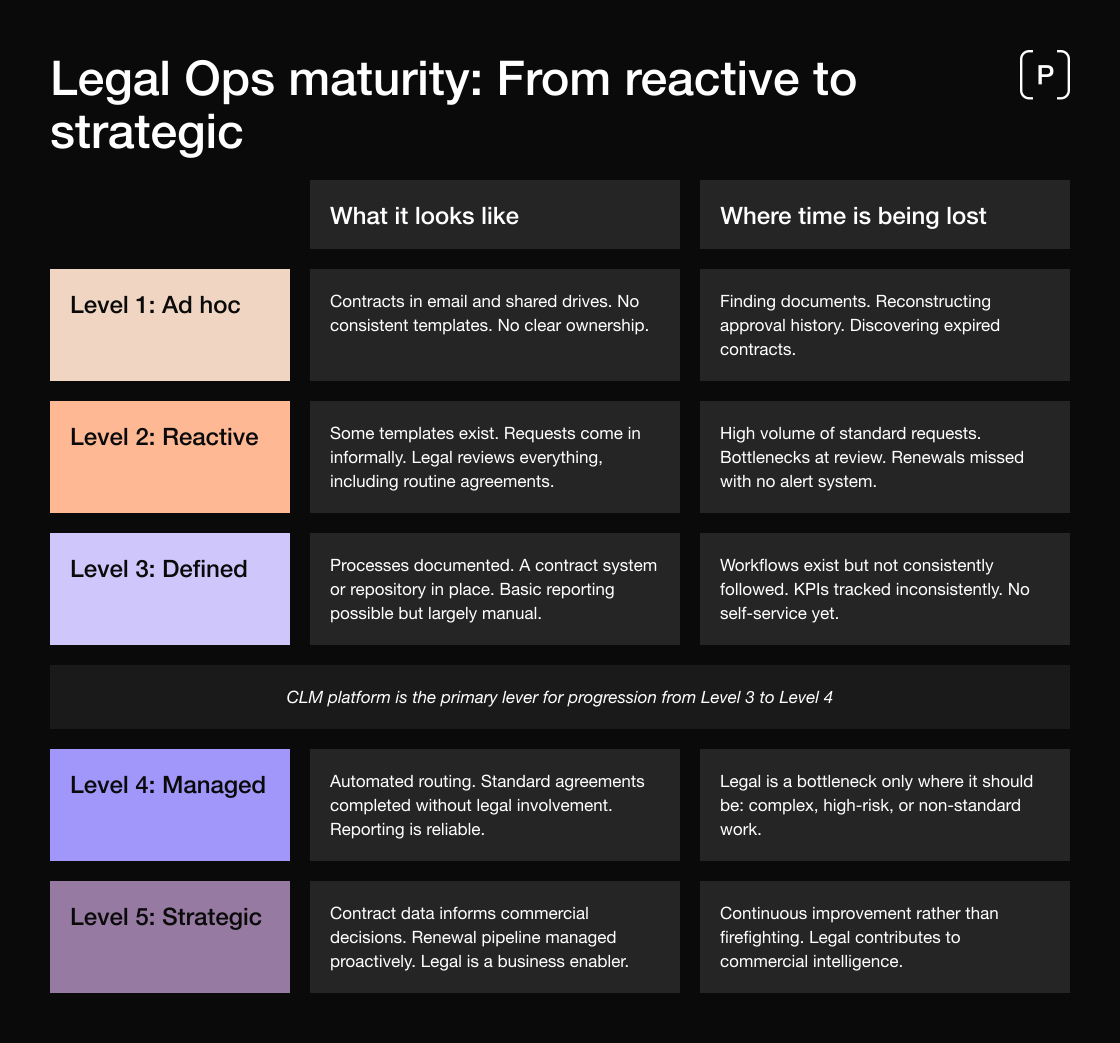
Understanding where your function is today is the starting point for any improvement. The model below describes five recognisable stages. Most in-house legal teams sit somewhere between Level 2 and Level 3.
The move from Level 2 to Level 3 is primarily a process and culture challenge: agreeing what the process should be and documenting it. The move from Level 3 to Level 4 is primarily a technology decision: putting a system in place that enforces the process automatically rather than relying on individuals to follow it.
"I'm trying to reduce the time that my team spends reviewing the agreement for them to have more free time to work on the more challenging stuff." In-House Legal Counsel, a global fintech company in payment solutions
If you want a structured view of where your contract process stands today, Precisely's free Contract Management Health Check covers the areas this guide addresses: how contracts are created, how approvals work, how renewals are tracked, and how visible the process is. Seven questions, three minutes, no sign-up required.
The KPIs legal ops teams are increasingly asked to report on
Management expectations for legal ops reporting have grown alongside the function's profile. Tracking legal ops performance consistently is also what allows a legal team to make the case for investment in better tooling. The following metrics are the most commonly requested and the most meaningful for demonstrating operational impact.
Contract cycle time
The time from initial request to signed contract. Track it by contract type to understand where the process is consistently slow rather than occasionally delayed. Breaking cycle time into stages, such as time in legal review, time awaiting business approval, and time at signature, shows where the bottleneck actually sits. Most slow contracts are fast at every stage except one.
"I would like to know the time they take to review and to send an agreement to the requester... and who made the decisions during the negotiation." In-House Legal Counsel, a global fintech company in payment solutions
Request volume by department
Which business areas generate the most contract requests? This determines where self-service templates have the highest impact and provides the data to prioritise template development.
Renewal and expiry visibility
What proportion of contracts approaching renewal were flagged in advance rather than discovered after the fact? This is one of the most financially significant metrics in legal ops and one of the easiest to improve once a system is in place.
Unsigned and incomplete agreements
The proportion of contracts initiated but never completed. Without a system that tracks status through to completion, this number is invisible until the consequences become apparent.
The difficulty most legal ops teams face is not understanding what these metrics mean. It is that without a structured contract system, they cannot produce them. The data exists in email threads, shared folders, and calendar reminders, not in a form that can be reported.
The most common legal ops challenges and what addresses them

Volume growth without headcount growth
Adding capacity is rarely available as an option. The effective response is removing work from the legal team's critical path. Self-service templates allow non-legal staff to initiate and complete standard agreements within guardrails that legal defines, without legal involvement in each individual contract. Automated approval routing removes manual chasing. Legal efficiency improves not by working faster but by eliminating the work that should not require a lawyer in the first place.
Template inconsistency across the organisation
When templates are maintained individually by different lawyers, they diverge over time. Different versions of the same agreement circulate. Clause language becomes inconsistent. An update to one template does not reach the others.
The fix is a centralised template library where legal owns the approved language and any change to a clause is reflected automatically across every template that references it. Without this, keeping templates accurate is a continuous manual task.
No reliable view of the contract portfolio
"Just a broad analysis of where we have the possibility... it's taking weeks to collect those documents." General Counsel, a large European emergency services and healthcare company
This is a data problem before it is a technology problem. The starting point is deciding what metadata needs to be captured on every contract: counterparty, value, governing law, start date, end date, renewal terms, owner. Once that is defined and consistently applied, portfolio reporting becomes a query rather than an audit.
Contracts that are never finalised
Without a system that tracks status through to completion and alerts the responsible person when an agreement is overdue, unsigned contracts accumulate silently. The risk only becomes visible when the business tries to enforce an agreement that was never executed. For a fuller picture of where these challenges come from and how other teams are addressing them, see the contract management challenges guide.
Getting started when resources are already stretched
"Template drafting is too big for the moment and we don't have enough resources today to put that in place in the short term." Deputy General Counsel, a global private equity firm focused on the mid-market
The practical approach is to start with one contract type: the highest-volume, most-standardised agreement the team handles. Build that template properly before expanding. Starting with a broad programme means nothing gets finished.
When does a CLM platform become the right answer?
Most of the challenges described above can be partially addressed through better process discipline: agreed templates saved in a consistent location, a shared tracker, calendar reminders for renewals. For a very small team with low contract volume, this may be sufficient.
The point at which a CLM platform becomes the right investment is when the manual workarounds are themselves consuming significant time, when the team cannot produce basic reporting without a manual audit, or when self-service contracting, where non-legal staff complete standard agreements without legal involvement, is needed to absorb volume growth.
A CLM platform does not replace process discipline. It enforces it. It takes the workflows, templates, approvals, and metadata structures that have been defined and makes them the default rather than the exception. For a detailed walkthrough of what the full contract lifecycle looks like in a structured system, see the Contract Lifecycle Management guide.
What to evaluate in a CLM platform
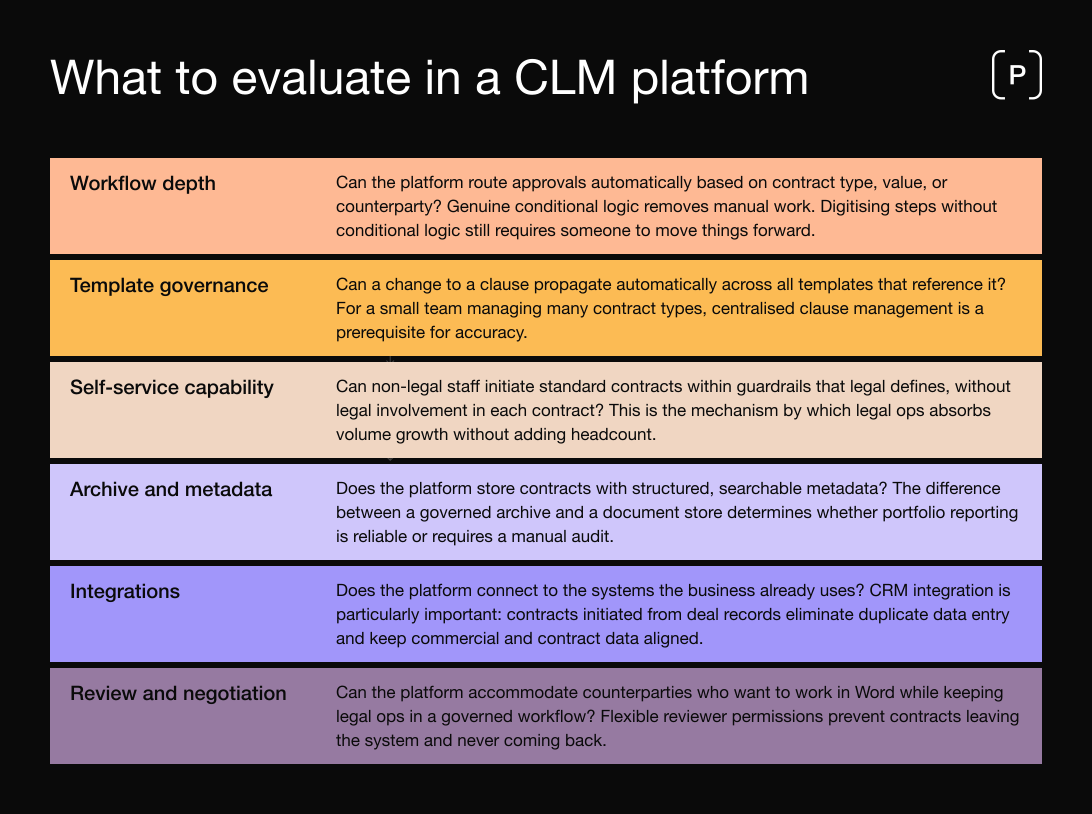
Workflow depth. Can the platform route approvals automatically based on contract type, value, counterparty, or other criteria? A platform with genuine conditional logic removes manual work from the process. A platform that only digitises the steps still requires someone to move things forward.
Template governance. Can a change to a clause propagate automatically across all templates that reference it? For a small team managing many contract types, centralised clause management is a prerequisite for keeping templates accurate over time.
Self-service capability. Can non-legal staff initiate standard contracts within guardrails that legal defines, without legal involvement in each contract? This is the mechanism by which legal ops absorbs volume growth without adding headcount.
Archive and metadata. Does the platform store contracts with structured, searchable metadata, or does it function as a document store with limited query capability? The difference determines whether portfolio reporting is reliable or manual.
Integrations. Does the platform connect to the systems the business already uses? CRM integration is particularly important for sales-driven workflows: contracts initiated directly from deal records eliminate duplicate data entry and keep commercial and contract data aligned.
Review and negotiation controls. Can the platform accommodate counterparties who want to work in Word while keeping legal ops in a governed workflow? Flexible reviewer permissions avoid the common failure mode of contracts leaving the system for negotiation and never coming back in.
How Precisely supports legal ops teams
Precisely is a Contract Lifecycle Management platform built for mid-market organisations that need automation, governance, and integration without the cost or complexity of enterprise systems.
Templates and self-service. Legal defines approved templates with conditional logic, variable clauses, and guardrails. Non-legal staff can initiate standard contracts without legal involvement. The template library is centrally managed: a change to a clause propagates across all templates that reference it.
Approval workflows. Workflows route automatically based on contract type, value, counterparty, or other criteria defined by legal. Approvers are notified and reminded without manual intervention. Every decision is recorded in the audit trail.
Archive and metadata. Contracts are stored in a structured, searchable archive. Metadata supports filtering, reporting, and bulk analysis. Natural language search, available to organisations with AI features enabled, allows the team to query the archive in plain language. No contract content is sent to any external AI model.
Renewal alerts. Automated notifications surface approaching renewals and expiry dates before they are missed.
Integrations. Precisely integrates with HubSpot, Salesforce, e-signature tools, ERP systems, and HR platforms. Contracts can be initiated directly from CRM deal records with data flowing through without re-entry.
Reporting. Contract volumes, cycle times, stage durations, and status data are available for export and reporting.
Review controls. Reviewers can be invited with granular permissions: view only, redline in Precisely, download to Word and re-upload, or both. This accommodates counterparty preferences without removing governance from the process.
ecosio: from a shared drive to 500 contracts a year
Wolfgang Vanas joined ecosio as its first in-house legal hire and inherited a shared drive full of contracts with no metadata, no clear ownership, and no visibility. After implementing Precisely, he described the outcome:
"Nothing goes unnoticed." Wolfgang Vanas, Head of Legal, ecosio
ecosio started with e-signing and archiving, then extended self-service contracting to the HR department. Four years on, the team handles over 500 contracts per year without missed renewals.