Key insights:
Why contract management is harder than it looks
Ask a legal or operations team to describe their biggest contract management challenge, and you will hear the same answers in almost every organisation: "We don't know where they all are." "Renewals keep catching us off guard." "It takes weeks to get a contract approved."
These are not failures of effort. They are structural problems that emerge when contract management relies on email threads, shared drives, and individual memory rather than a purpose-built system.
The challenge is compounded by the fact that contracts touch multiple teams. Legal drafts. Sales negotiates them. Finance tracks the commercial commitments. Procurement manages supplier obligations. HR handles employment agreements. When each team operates in its own system, or no system at all, the conditions for every challenge on this list are already in place.
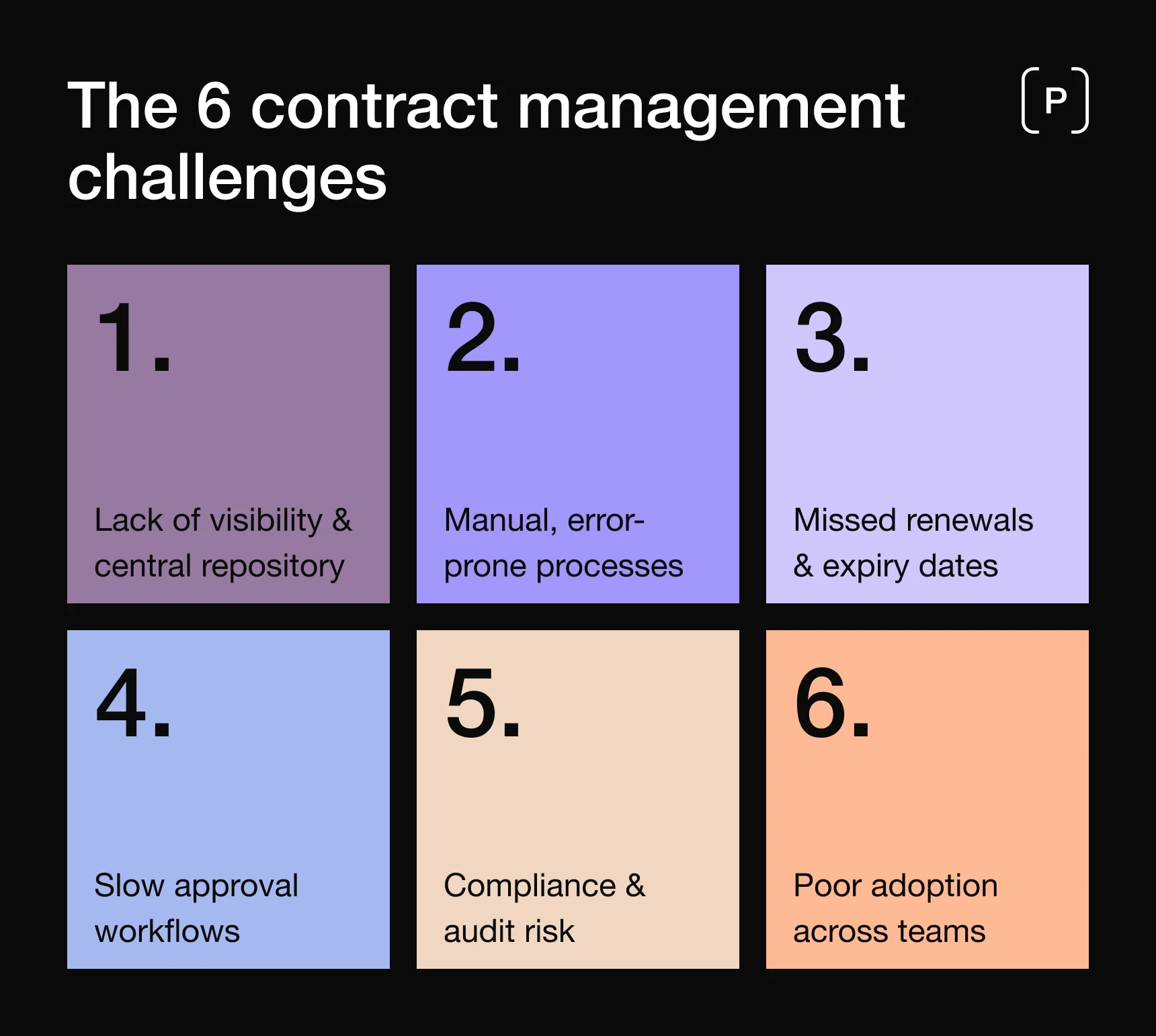
The six challenges below appear consistently across organisations of all sizes. Each one has a clear cause and a practical solution.
Challenge 1: Lack of visibility and a central repository
"We basically have no idea about our contract situation today. All our contracts are stored in someone's inbox. And if that person quit, for some reason, we have no way of knowing about the contract or retrieving it." (CFO, Swedish software company)
This is the most fundamental of all contract management challenges. Without a central repository, contracts end up distributed across email inboxes, shared drives, local folders, signing platforms, and HR systems. Sometimes all at once in the same organisation.
When someone needs to find a contract (before a renewal, during an audit, or when a key person leaves), the process becomes a manual search across multiple environments. Time is lost. Contracts are missed. In some cases, organisations simply do not know what agreements they are bound by.
The problem is not that people lack discipline. It is that there is no enforced process for where contracts go once they are signed. Without a structured archive, storage defaults to wherever the last person who touched the document left it.
What good looks like: A central, searchable contract repository where every agreement, whether created in the platform or uploaded from elsewhere, is stored with consistent metadata. Key fields such as counterparty name, contract type, start and end dates, and value should be extractable and searchable. Contracts should be findable in seconds, not minutes.
Precisely's archive provides full-text search across all stored contracts, with AI-assisted metadata extraction that automatically identifies and tags key fields on upload. Role-based access controls ensure that the right people can find what they need without exposing confidential agreements to the wrong teams. For more on how a CLM platform structures contract storage, see our guide to contract lifecycle management.
In practice: Sofie Storckenfeldt, General Counsel at Stureplansgruppen, Sweden's leading hospitality group with close to 4,000 employees, described her previous role as "navigating among thousands of unstructured files." Contracts existed in physical folders spread across office space, with no single place to check status or find a document. After implementing Precisely, her view changed: "If something is not in Precisely, it's not been approved by Legal." One system. One source of truth.
Challenge 2: Manual, error-prone processes
"We have lots of drafts but it's very manual. It's a work from V1 to V30. And it's also through emails and we would like to have just one place where you can start and finish the contract." (Attorney, global outdoor advertising company)
Manual contract processes introduce risk at every stage. When contracts are drafted in Word, shared by email, and returned with tracked changes, version control breaks down quickly. Thirty email-based versions, no clear record of which is current, and no audit trail of what changed and when. This is not an unusual situation. It is the default state for organisations that have not yet centralised their contract process.
Manual processes also introduce errors. Data entered from a CRM into a contract template by hand is data that can be entered incorrectly. Clauses copy-pasted from previous agreements carry the risk of carrying forward outdated terms. Approvals granted verbally or via email are approvals that cannot be tracked or demonstrated during an audit.
As contract volume grows, across counterparties, geographies, and contract types, manual processes do not scale. The time cost grows linearly with volume. The error rate does too.
What good looks like: Automated contract generation from pre-approved templates and CRM data, with conditional logic that ensures the right clauses appear based on deal type, jurisdiction, or counterparty. Changes tracked automatically. Version history preserved. No data re-entry.
Precisely generates contracts directly from templates built on conditional logic, pulling CRM data through integrations with HubSpot and Salesforce. This eliminates manual data entry, ensures clause consistency, and maintains a structured version history throughout the drafting and negotiation process.
Challenge 3: Missed renewals and expiry dates
"I have one which renews in five days and we still haven't finished the renewal process. Now it's at risk. And I'm going to have to rush through everything, leave my current priorities and look into it. Things like this keep coming up randomly where we make the plan for the week and then suddenly some renewal pops up." (Business Operations Manager, health and nutrition company, approx. 125 employees, Germany)
Missed renewals are not primarily a forgetting problem. They are a process problem. When renewal dates are tracked in a spreadsheet, a calendar entry, or a personal note, there is no guarantee that the right person will see the reminder at the right time. And when the person who manages that spreadsheet is on leave, or has left the company, the information is gone with them.
There are two distinct failure modes here. The first is a contract that expires without anyone noticing: an NDA that has lapsed, leaving the organisation without the protection it assumed was still in place. The second is a contract that auto-renews without anyone reviewing it: a software agreement that rolls over for another year at a cost nobody approved. Both cause real business impact.
The renewal cycle is also the right time to renegotiate terms, assess supplier performance, and update contract conditions. Organisations that manage renewals reactively, scrambling in the last few days, have no time to do any of this.
What good looks like: Automated reminders set against contract end dates, triggered well in advance (typically 90 and 30 days), sent to the contract owner and any relevant stakeholders. Renewal status visible in the central repository so no contract can lapse without deliberate action.
Precisely sends automated, configurable reminders tied to contract metadata, including end dates, notice periods, and renewal deadlines. Teams receive advance notice regardless of who currently owns the relationship, and the status of every renewal is visible in the archive at all times.
In practice: Wolfgang Vanas, Head of Legal at ecosio (a B2B integration company based in Vienna), described the situation before Precisely: "We had one or two occasions where a renewal was missed, and that, of course, had a financial impact. And it was something that we could only trace back to not having a proper system in place to keep track of those dates." Since implementing Precisely, ecosio has had zero missed renewals whilst processing over 500 contracts per year with a legal team of three.

Challenge 4: Slow approval workflows
"The main challenge is the time. It has to be approved by all our executives. So that takes so much time because it's a manual system. An executive is not around and I have to delay a bit. So sometimes we end up losing on important business agreements because of that." (Lawyer, hospitality and tourism group, sub-Saharan Africa)
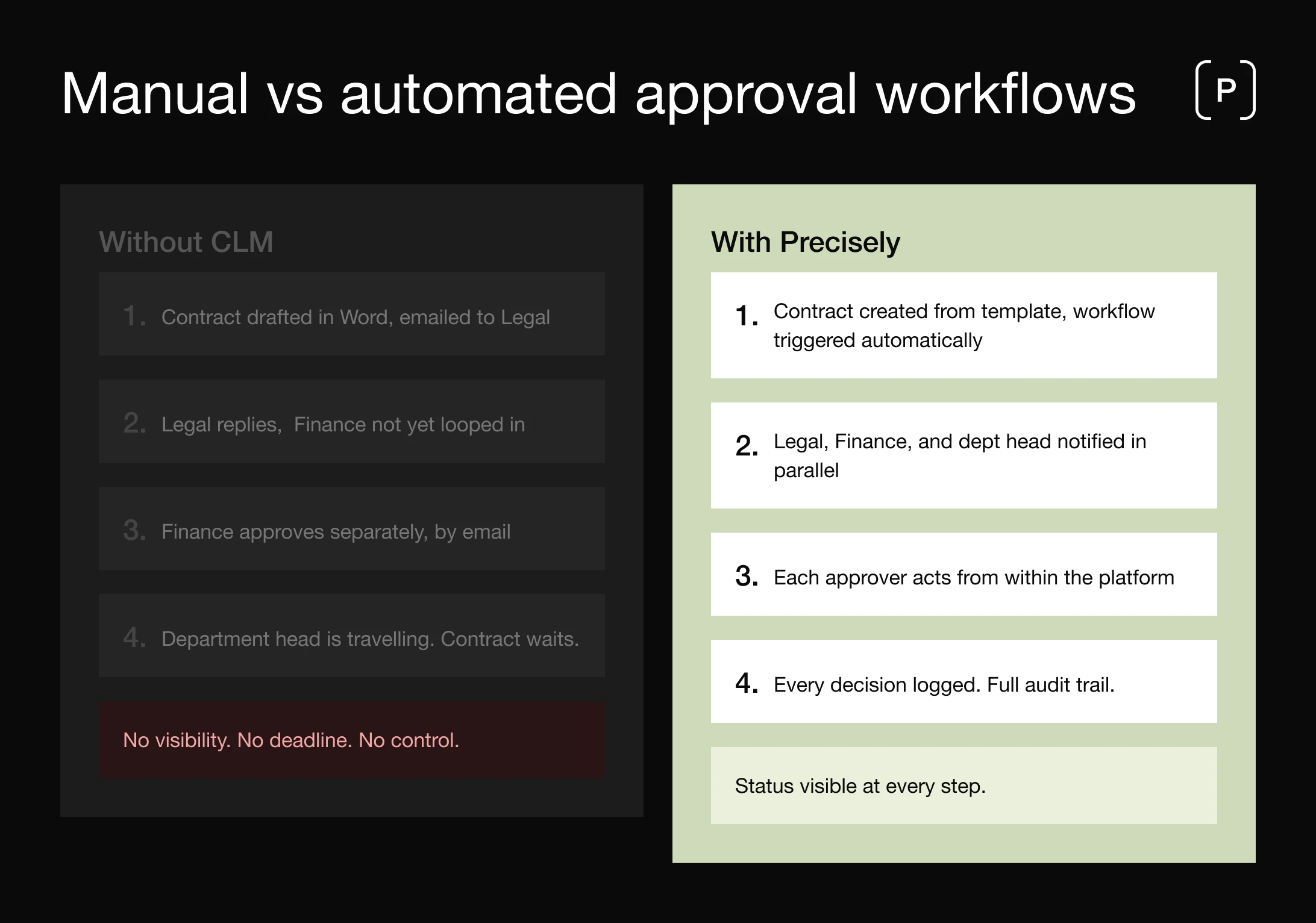
Approval workflows are one of the most consistently cited challenges of contract management. When approvals are routed manually, via email, shared inboxes, or ticketing systems, every step introduces delay and the possibility of contracts going silent. If the right approver is travelling, unresponsive, or simply unaware that their input is needed, the process stalls.
Multi-step approvals are the most vulnerable. A contract that requires sign-off from Legal, Finance, and the relevant department head can take weeks if each approval is a separate email thread. Each handoff is a point where the contract can sit unread in someone's inbox.
The cost is not only internal. Slow approvals affect counterparties too. Deals that take weeks to finalise create a poor experience for the other side and, in competitive situations, can result in lost business.
What good looks like: Automated approval routing based on contract type, value, counterparty risk, or other configurable rules. Approvers notified automatically when their input is required. Notification rules that alert approvers and relevant stakeholders if action is pending. A full audit trail of every approval decision.
Precisely routes approval workflows automatically based on rules defined by Legal or Operations. Approvers receive direct notifications, can act from within the platform, and every decision is logged. For contracts that meet pre-defined criteria, auto-approval rules can be set to remove unnecessary manual steps entirely. One RevOps contact described, before being shown the feature, as "huge for us."
In practice: Before Precisely, Flaconi, one of Germany's leading online beauty retailers, ran their entire approval process by email. Approvals took a long time and tracking contract status was a recurring problem. After implementing Precisely with automated templates and approval workflows, the team could take contracts from creation to signing "in no time at all." Samy Sayed, Product Finance Owner at Flaconi, noted that creating new templates, getting approvals, and e-signing were "understandable for everyone and easy to maintain."
For a broader view of how CLM platforms manage the contract lifecycle, see our contract management software guide.
Challenge 5: Compliance and audit risk
"That's why we have some kind of chaos in document system. Some folders are duplicated, and some documents are made more or less incorrectly, and some are not signed or are not fixed in the folder." (Legal, app store management platform, 70,000+ mobile teams globally)
Compliance risk in contract management comes in several forms. Contracts may be executed without the required approvals. Confidential terms may be accessible to people who should not see them. Document versions may be unclear, making it impossible to demonstrate which terms were agreed and when. Contracts may not meet archiving requirements, for example failing to meet PDF/A standards required for long-term legal validity.
During an audit, all of these gaps become visible. And by then, it is too late to reconstruct the paper trail.
GDPR adds another dimension for organisations handling personal data through contracts. Data processing agreements, standard contractual clauses, and supplier commitments need to be accessible, current, and demonstrably compliant. A contract management process that relies on ad-hoc storage makes GDPR compliance harder to demonstrate and easier to breach.
What good looks like: A system that enforces process by design: requiring approvals before a contract can be sent, restricting access based on role, generating a full audit trail for every action, and archiving signed documents in a legally compliant format. Compliance should be a built-in outcome of the process, not something that requires separate effort.
Precisely maintains a detailed, tamper-proof audit trail for every document. Signed contracts are archived in PDF/A format for long-term compliance. Role-based access controls ensure that confidential contracts are accessible only to authorised users. EU hosting means data residency requirements are met without additional configuration. See our related guide on contract management security best practices.
Challenge 6: Poor adoption across teams
"It was initially intended to be in our contract management system, but unfortunately, the system was so cumbersome and tricky to use that it was not really accepted by the team. So it was accepted by us but all the other specialist departments and heads..." (Senior Legal Counsel, Austrian automotive components manufacturer, approx. 1,000 employees)
A contract management system that nobody uses outside of the Legal team is not a contract management system. It is a storage tool for Legal. The challenges described above remain unresolved for every other team that continues managing contracts in email, spreadsheets, and shared drives.
Adoption is often treated as a change management problem. In practice, it is frequently a design problem. When a system requires extensive data entry, complex navigation, or significant training before it is useful, teams with higher-priority work simply do not adopt it. This is not resistance for its own sake. It is a rational response to a tool that creates more friction than it removes.
The consequence is that the process fractures along team boundaries. Legal uses the CLM. Sales continues to manage contracts in CRM. HR keeps employment agreements in its own folder structure. Procurement handles supplier agreements separately. No one has the full picture.
What good looks like: A system that fits into existing workflows rather than replacing them. Sales teams should be able to initiate contracts from their CRM. HR should be able to manage employment agreements without needing Legal involvement for standard cases. Non-legal users should be able to complete their part of the process quickly and without specialised training.
Precisely is built around the business user. No-code template workflows mean that non-legal teams can generate compliant contracts without legal involvement for standard cases, whilst Legal retains full control over the underlying logic and guardrails. CRM integrations (HubSpot, Salesforce) allow sales teams to initiate contracts directly from the tools they already use. Onboarding is structured around a 90-day implementation plan with dedicated customer success support.
In practice: At Adverity, a fast-growing B2B SaaS company in Vienna, the goal was simple: remove Legal from routine contract work without removing Legal's control. Today, over 70 users across 10 departments generate their own agreements independently. Half of all contracts require no legal input whatsoever. Fiona Konetzky, VP of Legal and Compliance, describes the shift: "I needed to automate our contract management as soon as possible and get rid of any repetitive work, as well as any mistakes when different teams were working together on different contracts." Contract turnaround is now 25 times faster than before.

How modern CLM platforms address these challenges
The six challenges described above share a common cause: contract management was designed around the individual rather than the process. Each person manages their own contracts, in their own system, in their own way.
Modern contract lifecycle management platforms address this by replacing individual habits with institutional process. The shift is not primarily about automation. It is about making the right process easier than the wrong one.
Key capabilities that address the challenges above directly:
- Central repository with structured metadata: every contract stored in one place, searchable by counterparty, date, type, value, and any other field the organisation defines. AI-assisted extraction automatically tags uploaded contracts with relevant metadata.
- Automated contract generation: contracts created from pre-approved templates using conditional logic, with data pulled directly from connected CRM systems such as HubSpot and Salesforce. No re-entry of data that already exists in your CRM. No version drift. Consistent clause usage enforced by design.
- Configurable renewal reminders: automated notifications sent to contract owners and relevant stakeholders at defined intervals before renewal or expiry. No contract can lapse or auto-renew without deliberate action.
- Rule-based approval routing: approval workflows triggered automatically based on contract type, value, or risk profile. Notification rules ensure approvers are alerted when action is needed. Every decision logged in a complete audit trail.
- Compliance by design: role-based access, PDF/A archiving, full audit trail, and EU data hosting combine to make compliance the default outcome of the contracting process.
- Adoption-first design: no-code workflows, CRM integration, and a 90-day onboarding programme ensure that the platform is used across teams, not just within Legal.
Ready to address your contract management challenges? Book a demo to see how Precisely handles contract storage, approvals, renewals, and compliance in a single platform.
Or explore our related guides: Contract Management Software: A Buyer's Guide, What is Contract Lifecycle Management?, Contract Management Best Practices, Contract Management in Procurement, GDPR and Contract Management.
Or read how other organisations solved the same challenges: How ecosio handles 500+ contracts a year stress-free, How Stureplansgruppen went from filing cabinets to a single source of truth, How Adverity reduced legal involvement by 50% across 70+ users, How Flaconi automated approvals and saved time across the business.